

The acronym ICE most commonly stands for In Case of Emergency, a label for one or more emergency contacts stored on a phone so first responders can reach someone quickly. It also names several unrelated things, including the U.S. agency Immigration and Customs Enforcement and the networking protocol Interactive Connectivity Establishment.
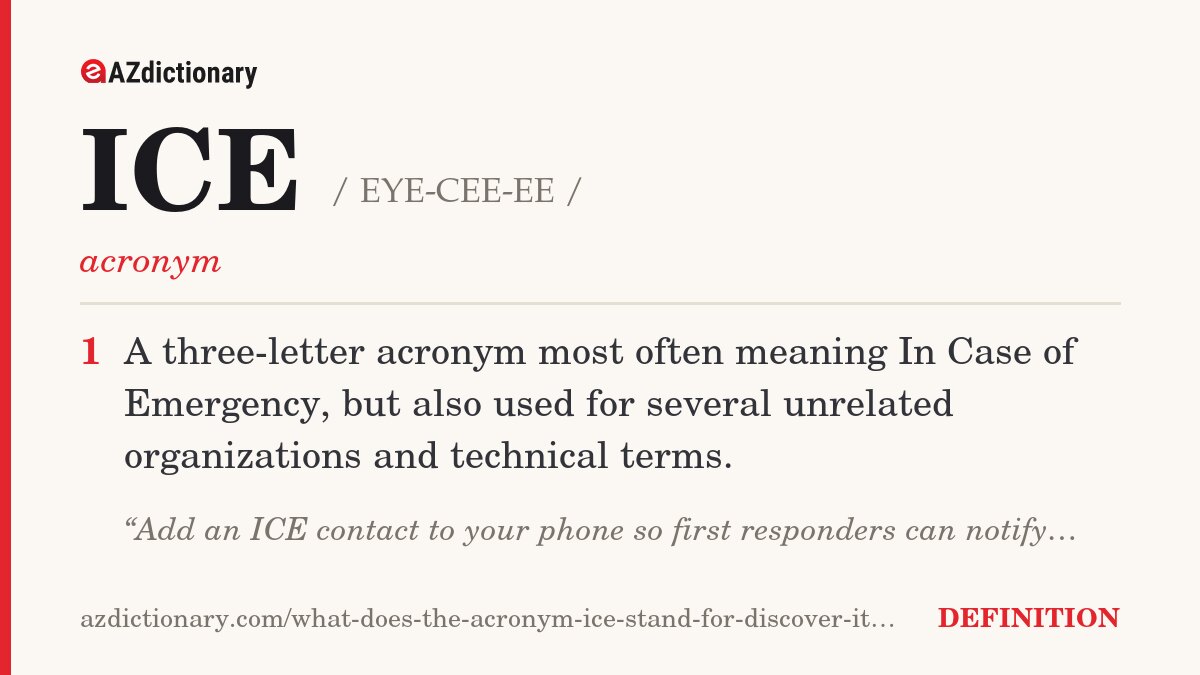
Part of speech: acronym
Pronunciation: EYE-CEE-EE
Meanings
- In Case of Emergency: a user-created contact label, often ICE or ICE1, used on mobile phones and medical ID lists so emergency personnel can find next-of-kin or important medical details. The idea was promoted by a British paramedic in the mid 2000s and is widely recommended by emergency services.
- Immigration and Customs Enforcement: the common short form for the U.S. federal agency that enforces immigration and customs laws. This is usually written in all caps, ICE, when referring to the agency. U.S. Immigration and Customs Enforcement
- Interactive Connectivity Establishment: a networking framework used by WebRTC and other realtime systems for NAT traversal and connecting two peers for audio or video. See the IETF specification for the protocol. RFC 8445
- Internal Combustion Engine: in automotive and engineering contexts, ICE commonly abbreviates internal combustion engine, the machine where fuel combusts inside the device to produce mechanical power.
- Institute of Culinary Education: a proper noun, often shortened to ICE for the New York and Los Angeles culinary school.
Origin
The phone-contact sense, In Case of Emergency, was proposed as a simple, easy-to-find label by a paramedic in the 2000s and spread through public-safety recommendations and media. Other senses are independent acronyms formed from each phrase’s initial letters and have separate institutional or technical origins.
Examples in sentences
- Add an ICE contact to your phone so paramedics can call a family member if you are injured.
- The homeowner found a notice from ICE about an immigration enforcement investigation.
- The WebRTC implementation uses ICE to choose the best network path between callers.
- The technician explained that older cars with ICE produce exhaust gases that electric vehicles do not.
- She enrolled at ICE to train for a career in professional cooking.
How the In Case of Emergency practice works in real life
- Choose one or more trusted contacts and save them in your phone under names like ICE, ICE1, ICE-MOM, or ICE-John.
- Include phone numbers and, where allowed, short medical notes such as allergies, chronic conditions, or blood type.
- Keep the phone unlocked or use the phone’s medical ID feature so responders can view the information while still respecting privacy.
- First responders or hospital staff who find the phone can look for ICE entries and contact the listed person to get medical history or permission for care.
Synonyms, antonyms and commonly confused words
Synonyms: emergency contact, medical ID, next of kin (contextual). Antonyms: nonemergency contact. Commonly confused: lowercase ice (frozen water) versus the capitalized acronym ICE (context matters).
FAQ
Q: What does the acronym ICE mean on a phone? A: On a phone, ICE usually means In Case of Emergency and marks a contact for first responders to call.
Q: Is ICE always the U.S. immigration agency? A: No, ICE can mean several things; when written in government contexts it often refers to U.S. Immigration and Customs Enforcement, but context determines the sense.
Q: Should I put medical details under ICE? A: Yes, brief critical medical notes are useful, but follow local privacy rules and use the phone’s official medical ID features when available.
Q: How is ICE used in networking? A: In networking, ICE stands for Interactive Connectivity Establishment, the process that finds and tests routes between peers behind NATs and firewalls.
