

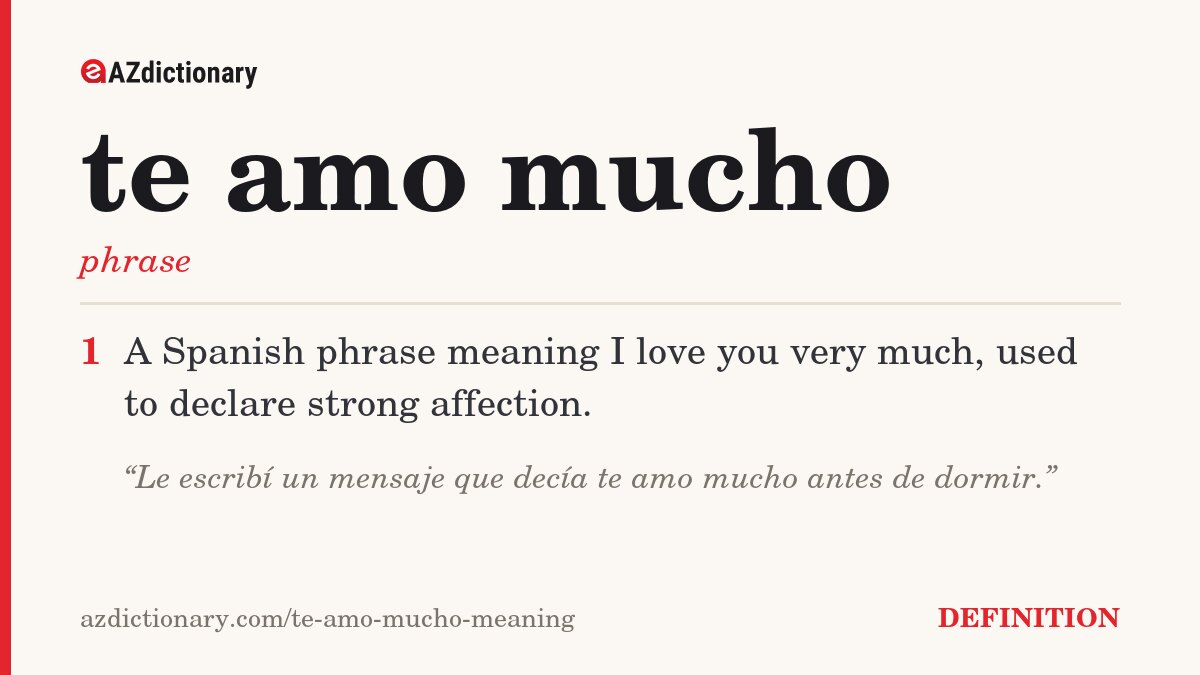
te amo mucho means I love you very much, a Spanish phrase used to declare strong affection in English. It uses the verb amar, the first person present te amo, plus the adverb mucho to add intensity. The phrase is common in romantic speech and in close family contexts to emphasize deep feeling.
Meanings
- Primary: A direct declaration of strong love, usually translated as “I love you very much” and most often used in romantic relationships.
- Family and close friends: Can be used toward close family members or lifelong friends to express deep affection rather than casual liking.
- Emphatic/hyperbolic use: Among some speakers, especially younger people, similar forms may be used playfully or hyperbolically to stress strong liking for a thing or event, though amar retains a stronger tone than querer.
Origin
The phrase combines the clitic object pronoun te, the verb amar (from Latin amare), and the adverb mucho (from Latin multum). The Real Academia Española treats amar as the verb meaning to feel love, and Spanish usage notes describe amar as carrying greater intensity than querer. See the RAE entry for amar and common translations at SpanishDict for usage examples: RAE: amar, SpanishDict: te amo mucho.
Examples in sentences
- Al despedirse, ella susurró te amo mucho y sonrió antes de subir al tren.
- Mi madre siempre me dice que me quiere, pero anoche me dijo que me ama mucho.
- En la tarjeta escribió, con letra temblorosa, te amo mucho, mi vida.
- Entre amigos cercanos se usa te quiero mucho más a menudo, reservando te amo para momentos especiales.
Synonyms, antonyms and commonly confused words
Synonyms: I love you very much, te amo muchísimo, te quiero mucho. Antonyms: no te amo, no te quiero. Commonly confused with: te quiero (a milder expression), te adoro (more reverential or poetic). Remember amar generally signals stronger, deeper love than querer.
FAQ
Does te amo mucho translate exactly as I love you very much?
Yes, the most direct English translation is I love you very much. Context and tone add nuance, but that is the standard equivalence.
Is te amo mucho more serious than te quiero mucho?
Typically yes: amar is commonly seen as stronger or more formal than querer, so te amo mucho often implies greater depth than te quiero mucho, though regional and personal use varies.
Can you say te amo mucho to family members?
Yes. Many people use it with parents, children, or close relatives to stress deep affection, though some families prefer te quiero mucho in everyday speech.
Is it appropriate in writing and speech?
Yes. It is natural both spoken and written. Because it expresses strong feeling, people choose it for heartfelt messages, declarations, and intimate moments.
