

Simulacra are images, copies, or representations of something else. In ordinary use the word names likenesses or imitations; in postmodern theory, following Jean Baudrillard, simulacra are representations that detach from any original and can function as their own reality.
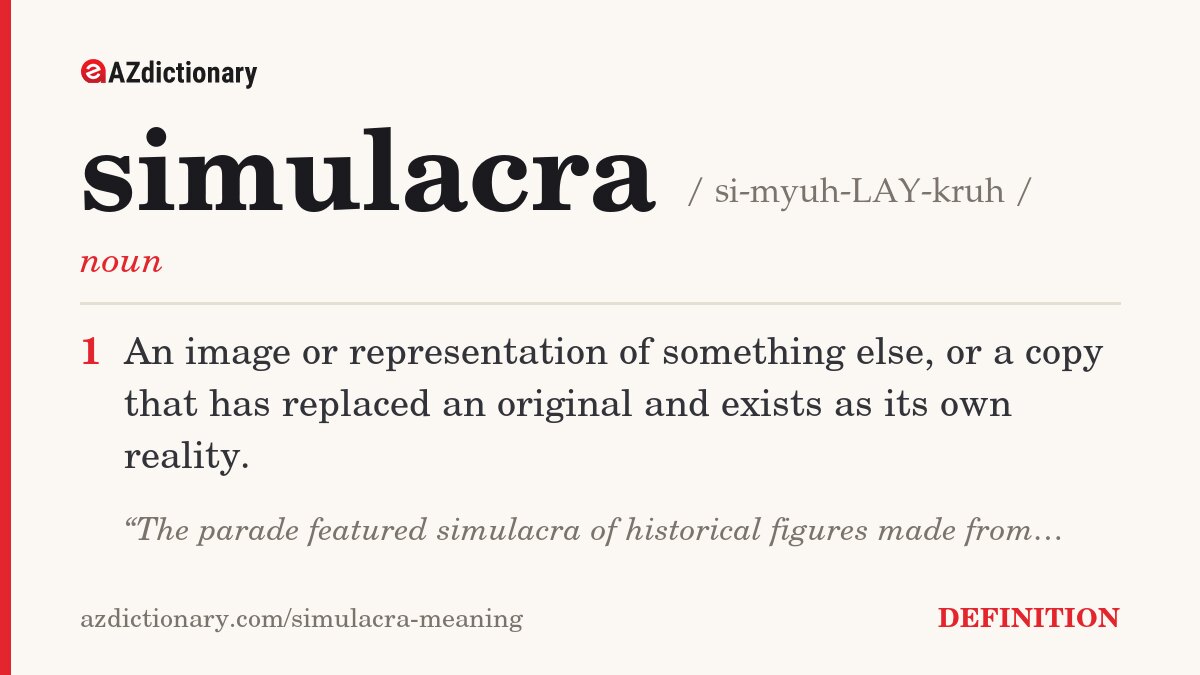
Part of speech: noun (plural of simulacrum)
Pronunciation: si-myuh-LAY-kruh
Meanings
- Any image or representation of a person, thing, or idea, for example a portrait, model, or facsimile. This is the traditional dictionary sense.
- In modern critical theory, a representation or sign that has become detached from an original referent and circulates as its own reality, often described as producing a hyperreality. This sense is associated with Jean Baudrillard.
Origin
The word derives from Latin simulācrum, from simulāre, to imitate, and similis, like. English has used the term since the Middle English period; the plural can be simulacra or simulacrums. See the Collins entry for the classical etymology.
How it works in practice
1. A representation is created to stand in for something else, for example a model, advertisement, or staged scene.
2. The representation circulates widely and is repeated, becoming familiar independent of the original.
3. Over time the representation can come to shape perceptions and expectations so much that people treat it as if it were the real thing, or they no longer distinguish between the representation and any prior original. In Baudrillard’s account, this process produces a hyperreal environment where signs refer to other signs rather than to an external reality.
Examples in sentences
- The wax museum displayed simulacra of historical leaders, each a careful likeness rather than the person itself.
- After years of glossy travel ads, the seaside town felt like simulacra of itself, tailored to cameras more than residents.
- Baudrillard argued that theme parks are simulacra that make the surrounding city seem like the imitation.
- The online profile was a simulacra of the real person, edited and curated for appearance.
Synonyms, antonyms and commonly confused words
Synonyms: likeness, representation, copy, facsimile, imitation. Antonyms: original, prototype, exemplar. Commonly confused words: simulation (the act or process of imitating), simulacrum (the singular form), and replica (a close physical copy).
FAQ
What does simulacra mean? It means images or representations of something else, and in theory it can mean copies that no longer refer to any original.
Is simulacra singular or plural? Simulacra is the plural of simulacrum; some writers also use simulacrums as an English plural.
How is simulacra different from simulation? Simulation names the process of imitating; simulacra are the resulting images or copies. In critical theory the two ideas are linked, since simulations produce simulacra.
Further reading: see the Collins dictionary entry for the standard lexical sense and Jean Baudrillard’s essay on simulacra and simulation for the theoretical sense. Collins: simulacre / simulacrum Baudrillard, “Simulacra and Simulations” (Stanford text)
Related Words
- simulacrum
- simulation
