

Parity is the state of being equal or corresponding, or the property of an integer or binary group of bits being even or odd. The term is used for social or economic equality, for even/odd classification in mathematics, for simple error checking in computing, and for spatial symmetry in physics.
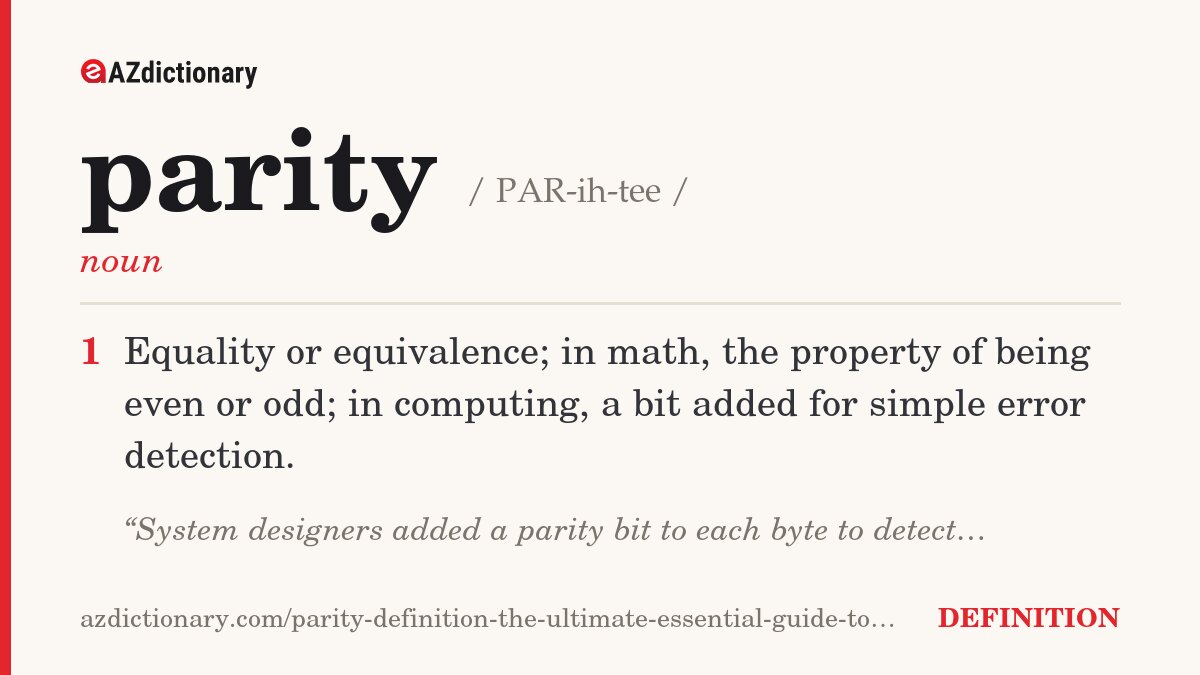
Part of speech: noun
Pronunciation: PAR-ih-tee
Meanings
- General equality: A condition of equivalence in amount, status, or value, for example pay parity between two groups.
- Mathematics: The property of an integer being even or odd. An even number has parity even, an odd number has parity odd.
- Computing and information theory: A parity bit is an extra binary digit added to a set of bits so a receiver can detect whether a single-bit error occurred; some processors also use a parity flag to record evenness or oddness of set bits.
- Finance and economics: Equality in value between units, for example currency parity when two currencies have the same value, or price parity in markets.
- Physics: A symmetry property under spatial inversion, described as even or odd parity for physical states and operators.
Origin
The word parity comes from Latin paritas, from par, meaning equal. The sense of equality and the mathematical sense of evenness both appear in authoritative dictionary entries. See the Oxford Learner’s Dictionary and Cambridge Dictionary for standard definitions and pronunciation.
Oxford Learner’s Dictionary: parity and Cambridge Dictionary: parity.
Examples in sentences
- The union argued for pay parity with other public-sector employees.
- An even integer has parity even, while 7 has parity odd.
- The communication protocol appends a parity bit to each byte to detect errors in transmission.
- Traders watched for parity between the euro and the dollar after the announcement.
- Under spatial inversion the system showed odd parity, so the wavefunction changed sign.
How it works (computing parity bit, step by step)
1. Choose even parity or odd parity. For even parity, the parity bit makes the total number of 1 bits even; for odd parity, it makes the total number odd.
2. When sending data, compute the parity bit from the data bits and append it to the transmitted block.
3. The receiver recomputes parity on the received data and checks it against the received parity bit. A mismatch signals that an odd number of bit errors occurred.
In practice, parity bits provide simple single-error detection. They cannot reliably detect an even number of flipped bits, and they do not locate which bit is wrong; more advanced codes are used when correction or stronger guarantees are needed.
Synonyms, antonyms and commonly confused words
Synonyms: equality, equivalence, sameness. Antonyms: inequality, disparity. Commonly confused words: parity and parity bit (parity is the general concept; parity bit is the specific error-checking bit), parity and symmetry (overlap in physics but not identical in all contexts).
FAQ
What does parity mean? Parity means equality or equivalence, or in mathematics the property of being even or odd. The exact sense depends on context.
What is parity in computing? In computing, parity is a simple error-detection method that adds a parity bit so the receiver can tell if an odd number of bits flipped during transmission.
What is parity in finance? In finance, parity usually refers to equality of value, for example when two currencies trade at equal exchange value or when prices are kept equal across markets.
How reliable is a parity bit? It is reliable for detecting single-bit errors but will miss errors that flip an even number of bits and cannot correct errors by itself.
