

A papule is a small, solid, raised bump on the skin, usually less than about 1 centimetre across, that is palpable and distinct from the surrounding surface. It may be red, pink, brown, or skin coloured and is a common primary skin lesion described by clinicians.
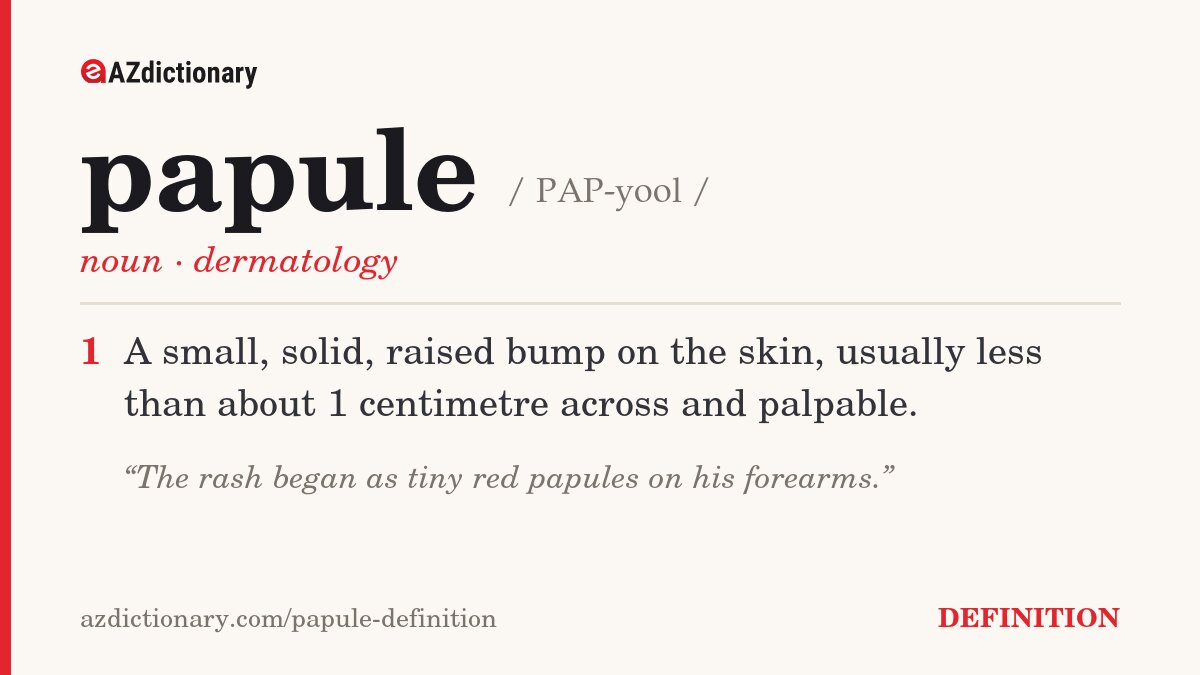
Part of speech: noun
Pronunciation: PAP-yool
Meanings
- In dermatology, a papule is an elevated, solid, palpable lesion that is generally under 1 centimetre in diameter. It is a basic descriptive term for a small bump on the skin.
- Practically, authors and clinical guides differ on exact size limits: some sources use 1 centimetre as the cutoff, while others set a smaller limit of 5 millimetres or 0.5 centimetres; larger solid elevations are often called nodules.
- Although usually solid, the term can include small cystic or dome shaped lesions in certain contexts, while lesions that contain pus are described as pustules rather than papules.
Origin
The word comes from Latin papula, meaning a small pimple or swelling; English adoption and medical use preserve that sense of a small raised lesion on the skin.
Examples in sentences
- The rash began as tiny red papules on his forearms that itched in the evening.
- A dermatologist examined the patient and described several discrete papules on the chest and upper back.
- Acne often produces both papules and pustules, the former solid and the latter containing pus.
- Some benign growths, like pearly penile papules, are papular but harmless variations of normal skin.
- On inspection the lesions were flat macules, but later they raised into papules as the inflammation increased.
Synonyms, antonyms and commonly confused words
Synonyms: bump, elevation, lesion (general). Antonyms: macule (a flat, nonpalpable discoloration). Commonly confused words: papule versus pustule, where a pustule contains pus; papule versus nodule, where a nodule is a larger, deeper solid lesion.
FAQ
What is the difference between a papule and a pustule?
A papule is usually a solid raised bump; a pustule is similar in size but contains pus and often has a yellowish tip.How big is a papule?
Definitions vary: many references use under 1 centimetre, while some clinical guides set the limit at 5 millimetres, so clinicians describe both size and feel when documenting lesions.Is a papule always painful?
Not always. Papules can be itchy, tender, or asymptomatic, depending on the underlying cause.When should I see a doctor about papules?
See a clinician if papules are widespread, persistent, rapidly changing, painful, bleed, or are accompanied by other symptoms; a professional can identify the cause and need for treatment.
For standard dictionary wording see Merriam-Webster, and for clinical lesion terminology see the dermatology terminology guide at DermNet NZ.
Related Words
- nodule
