

Leopardess: a female leopard, the adult female of the spotted big cat Panthera pardus. The word names the female specifically, though in many contexts writers and speakers simply use leopard for either sex. This term appears mainly in nature writing and traditional zoological usage.
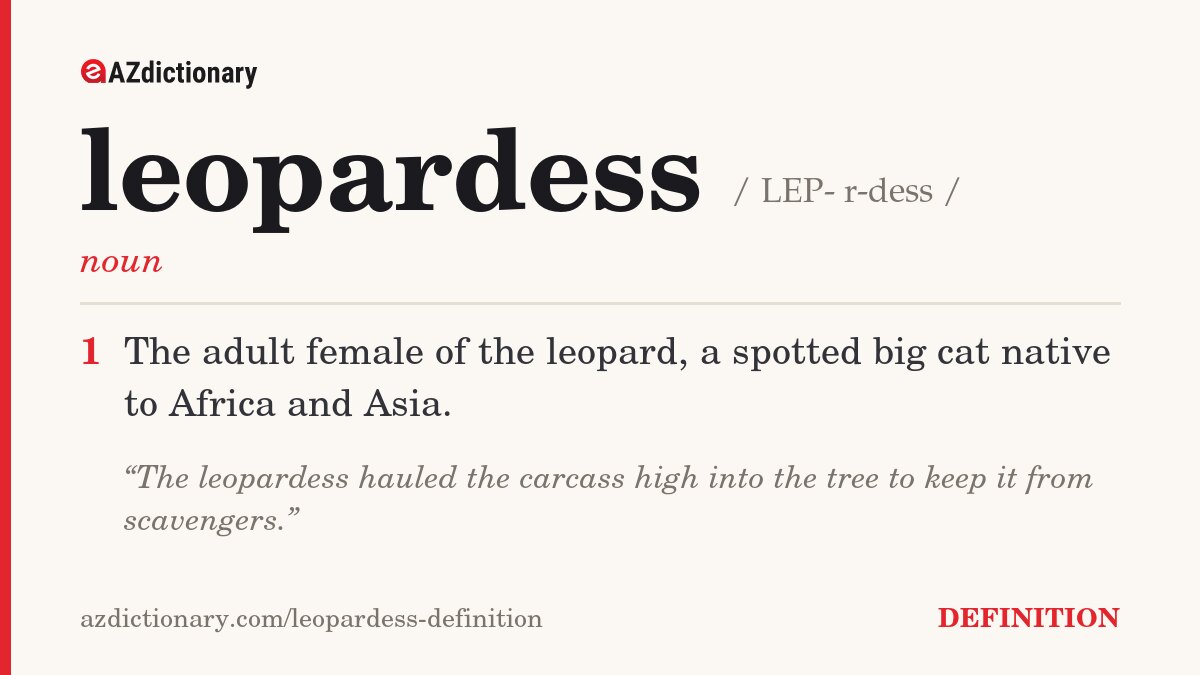
Part of speech: noun
Pronunciation: LEP-ər-dess
Meanings
1. A female leopard, the adult female of the species Panthera pardus. In modern usage the simple form leopard is commonly used for either sex, so the feminine form is relatively rare.
Origin
The word was formed by adding the feminine suffix -ess to leopard. The formation is old and parallels other animal forms like lioness and tigress. The feminine suffix and the base word date to the early modern period, and the specific feminine form appears in texts from the 16th century onward.
Examples in sentences
- The leopardess dragged her prey up into the fork of a tall acacia, out of reach of hyenas.
- Researchers recorded a mother with two cubs, the female guiding them through dense scrub.
- In the documentary the narrator described how the female guards the den while cubs are young.
- A photographer waited until the female slipped from the shadows to catch a clear shot of her coat.
- Though the book uses the feminine form, most field reports simply note the presence of leopards without specifying sex.
Synonyms, antonyms and commonly confused words
Synonyms: female leopard. Antonyms: none exact, since the male is simply male leopard. Commonly confused words: leopard, lioness, tigress. Note that leopard is normally sufficient to refer to either sex.
FAQ
What does leopardess mean?
A leopardess is the adult female of the leopard species, Panthera pardus. The word specifies the female rather than using the gender-neutral leopard.
Is leopardess still correct to use?
Yes, it is a correct English word, though it is less common in everyday speech; many writers just use leopard for either sex.
How do you pronounce the word?
Pronounce it LEP-ər-dess, with primary stress on the first syllable.
When should I use the feminine form?
Use the feminine form when the sex of the animal is relevant, for example in natural-history writing, reports on maternal behaviour, or when distinguishing mother from male in field notes.
For authoritative dictionary entries see Dictionary.com and the Oxford Learner’s entry at Oxford Learner’s Dictionaries.
Related Words
- leopard
- lioness
- panther
