

Wrest means to pull or twist violently, or to obtain something by force or with difficulty. The verb is often followed by a preposition, for example wrest control from, and the noun can mean the action of wrenching or, archaically, a small wrench used to tune a stringed instrument.
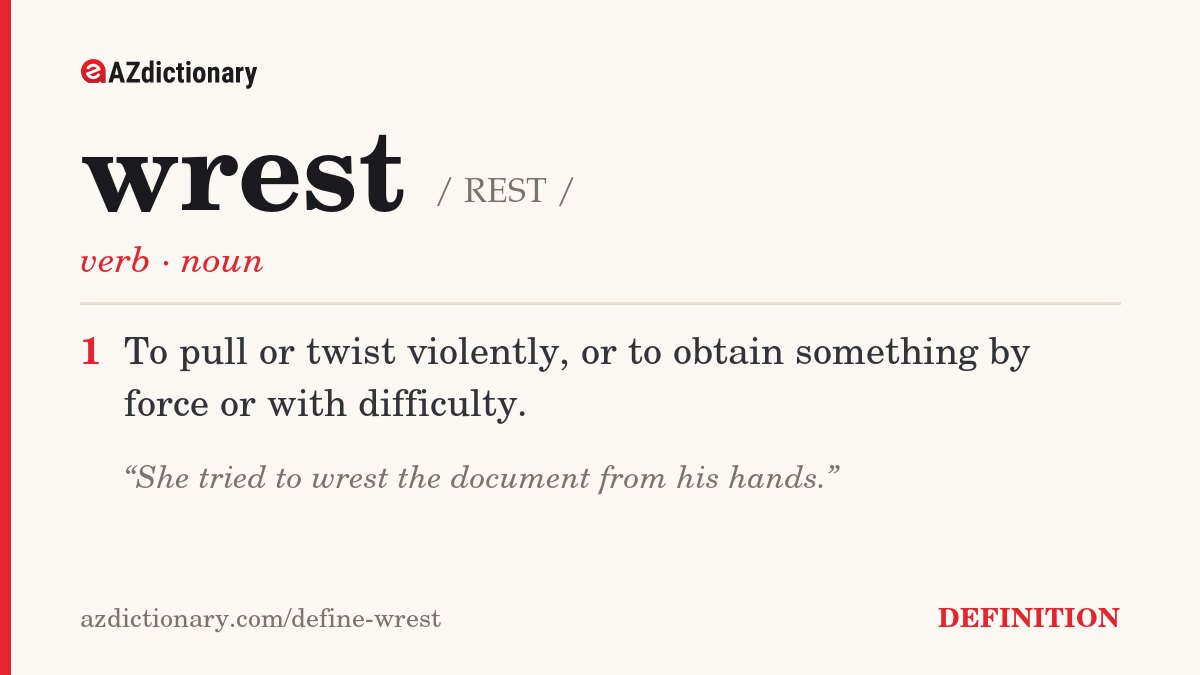
Part of speech: verb, noun
Pronunciation: REST
Meanings
- Verb: To pull, force, or move by violent wringing or twisting movements, for example to wrest a tool away. (transitive)
- Verb: To gain or take something with difficulty, as if by force, for example to wrest control or concessions. (transitive, often followed by from, away from, or out of)
- Noun: The action of wrestling or wrenching; a wrenching movement. In older usage, a small key or wrench for turning pins on a stringed instrument.
Origin
The word comes from Middle English forms such as wresten, from Old English wrǣstan, meaning to twist forcibly. Linguists trace it to Proto-Germanic roots related to bending and twisting. For modern dictionary entries see the Merriam-Webster entry for wrest and the Wiktionary entry for wrest.
Examples in sentences
- She managed to wrest the pen from his hand before he could sign the paper.
- The reformers tried to wrest power from the entrenched leadership.
- He wrested a confession from the suspect after hours of questioning.
- The antique piano still needed a special wrest to tighten the strings, a use now largely archaic.
- Investors wrested a change in policy from the board after months of pressure.
Synonyms, antonyms and commonly confused words
Synonyms: pry, pull, wrench, extract, seize. Antonyms: give, surrender, release. Commonly confused with: wrestle, which usually implies a physical struggle or contest and is a related but distinct verb; wrench, which is both a noun and a verb meaning to twist or jerk forcefully and overlaps in sense.
FAQ
- What does wrest mean? Wrest means to pull or twist violently, or to obtain something with difficulty or by force. It is mainly used as a transitive verb.
- Is wrest the same as wrestle? No. Wrest is typically transitive and focuses on taking or twisting by force, while wrestle refers to struggling or grappling and can be intransitive or transitive.
- Can wrest be used figuratively? Yes. Common figurative uses include wrest control from, wrest a confession from, or wrest meaning from a text, where wrest implies forceful extraction.
- Is wrest still used as a noun? Rarely in modern English. The noun meaning is mainly the action of wrenching; an obsolete noun sense named a small tuning wrench for stringed instruments.
