

A veto is the formal power to reject or stop a proposed action, law, or decision, usually exercised by a person or body with special authority. In ordinary use, to veto something is to refuse to allow it to proceed, either as a noun or as a verb.
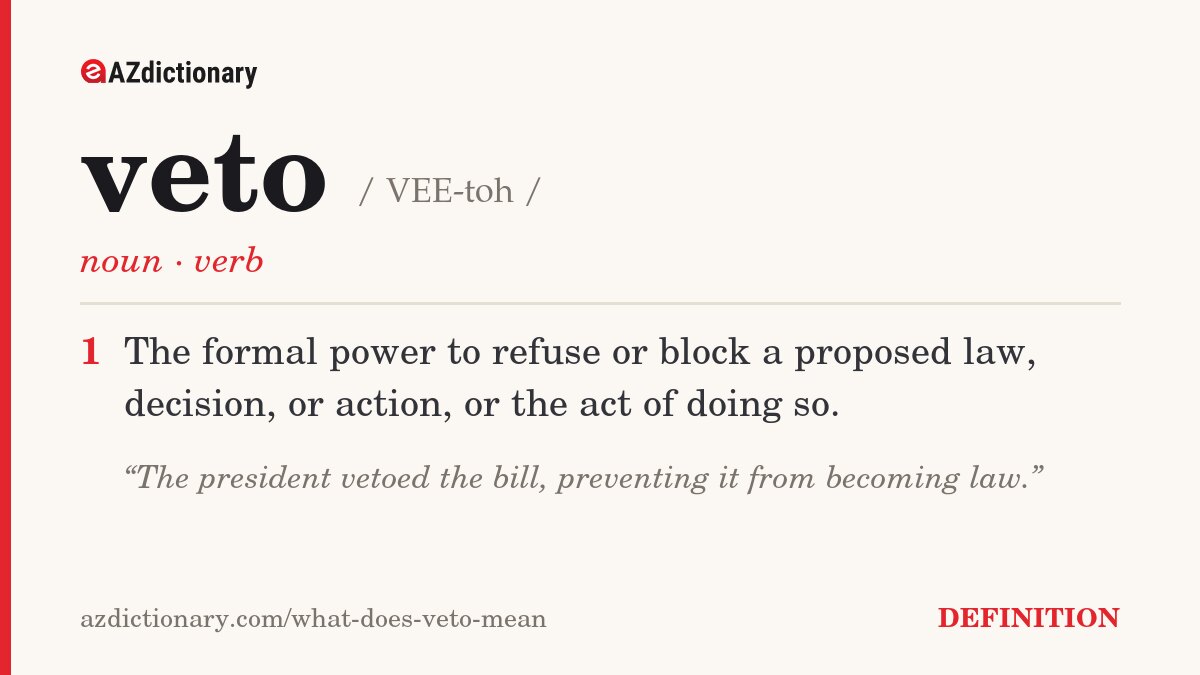
Part of speech: noun · verb
Pronunciation: VEE-toh
Meanings
1. The right or power to forbid or block a decision, especially a law or official proposal. This is the common, institutional sense used for executives, boards, or privileged members of a body.
2. The act of using that power: a formal negative vote or written refusal that prevents enactment.
3. Informal sense: to reject or rule out an idea or suggestion in everyday conversation, without legal force.
Origin
The word comes from Latin veto, literally “I forbid,” the first person singular present of vetare, “to forbid.” English adopted the word in the early 17th century with the same basic meaning. See modern dictionary entries for pronunciation and definitions at Cambridge. Cambridge Dictionary.
How it works
The specific procedure depends on the institution, but the basic steps are:
- A proposal is adopted or passed by a decision-making body, such as a legislature, board, or committee.
- The holder of veto power formally records a refusal, or casts a negative vote, according to the rules that govern that body.
- The veto prevents the proposal from becoming effective unless the body has a way to overturn it, typically by a supermajority vote or other override mechanism.
For example, in the United States federal system the President may veto bills passed by Congress; Congress can override that veto with a two thirds vote in both houses. For more on the legal definition in a U.S. context, see the Legal Information Institute. Cornell LII.
Examples in sentences
- The governor exercised a line item veto to remove the funding provision from the budget bill.
- The council voted to approve the plan, but the mayor vetoed the ordinance.
- As a permanent member of the Security Council, a state may cast a veto on substantive resolutions.
- The board vetoed the chief executive’s proposal to close the branch office.
- They vetoed my suggestion for the meeting location and chose a different venue.
Synonyms, antonyms and commonly confused words
Synonyms: block, reject, forbid, disallow, prohibit. Antonyms: approve, ratify, endorse. Commonly confused terms: “override” is the action that defeats a veto; “pocket veto” is a specific type of executive veto that depends on timing and the legislature’s adjournment.
FAQ
What does veto mean? A veto is the power or act of refusing to allow a proposed decision or law to take effect, usually exercised by an authorized individual or body.
Who can veto laws? That depends on the system: presidents, governors, some executives, boards, and the five permanent members of the UN Security Council are familiar examples of veto-holders, but rules and scope vary by jurisdiction and institution.
Can a veto be overridden? Often yes, but only by the mechanism specified in the governing rules, commonly a supermajority vote. The required threshold and method differ by institution.
Is veto always absolute? No. Some vetoes are absolute, some are suspensive or partial, and legal and political constraints can limit how and when the power is used.
