

brea is a Spanish noun meaning a dark, viscous substance, equivalent to tar or pitch. In Spanish and related technical use, it names the resinous material used for waterproofing, caulking and medical ointments, and it also appears as a maritime mixture, a tarred cloth, and in several place names.
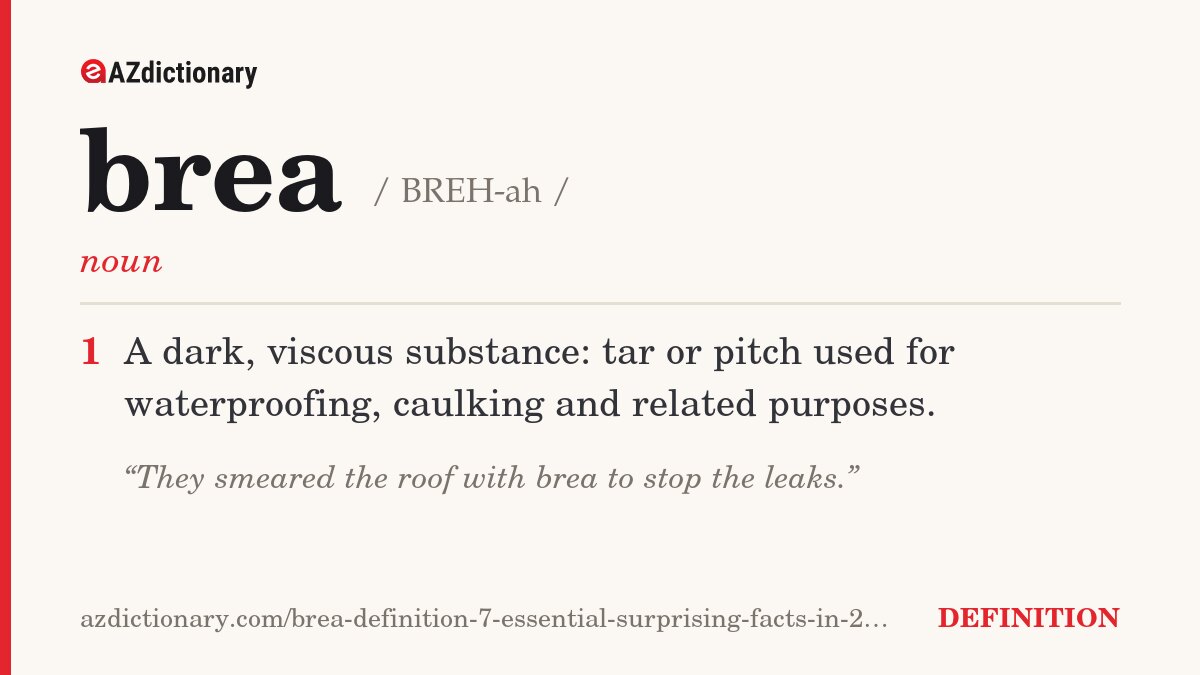
Part of speech: noun (feminine).
Pronunciation: BREH-ah
Meanings
- Tar or pitch: a dark, sticky, resinous substance obtained by distilling wood, coal, petroleum or other organic matter, used for waterproofing, paving and medicinal preparations. This is the primary sense in modern Spanish.
- Maritime mixture: a blend of brea, pitch, tallow and fish oil used hot to caulk and protect wooden hulls and rigging.
- Tarred cloth: a coarse canvas or covering impregnated with brea for protecting goods during transport.
- Botanical: the name of a Chilean shrub whose resin was once used like brea in some local contexts.
- Place names and surnames: brea appears in toponyms, for example La Brea (as in La Brea Tar Pits) and the city of Brea, California; in those cases the name references natural asphalt or tar deposits.
Origin
The word is well established in Spanish lexicography. Modern authorities define brea as tar, pitch and related substances. The Diccionario de la lengua española lists several senses, including brea crasa and brea líquida, and notes historical uses in maritime contexts. Linguists trace the Spanish verb brear and the noun to Romance contact with Old French and Occitan forms such as brayer and brèa, with a likely Germanic element behind the French form; the precise deeper origin is uncertain.
See the Real Academia Española entry for brea and a standard English-Spanish dictionary entry for comparative senses: Real Academia Española: brea, Collins Spanish-English: brea.
Examples in sentences
- Los marineros embrearon las cuadernas del barco antes de la travesía.
- El camino estaba cubierto de brea para sellar las juntas del empedrado.
- Historiadores usan el término brea para describir el alquitrán que emergía en La Brea.
- Aplicaron jabón de brea y agua para limpiar la madera ennegrecida.
- La tela estaba embreada para proteger la carga de la lluvia.
Synonyms, antonyms and commonly confused words
Synonyms: alquitrán, betún, pez, asfalto. Antonym: none exact, but words like limpio or incombustible are opposites in some contexts. Commonly confused words: “brea” versus “brasa” (ember) and “breña” (scrubland); do not confuse the technical Spanish noun with English toponyms that include La Brea, which refer to tar deposits.
FAQ
What does brea mean in English? In English contexts it translates as tar or pitch, a sticky, dark, resinous material used for sealing and waterproofing.
Is brea the same as asphalt? Brea overlaps with asphalt and bitumen in everyday use, especially when referring to natural tar or mineral brea, but precise industrial terms may distinguish them by source and composition.
Why are places called La Brea? Toponyms that include brea or La Brea refer to visible natural tar or asphalt seeps or to historical uses of tar in the area.
Can brea be used medically? Historic and folk uses include topical preparations and pectoral remedies, but modern medical use is limited and regulated; consult medical sources for contemporary treatments.
