

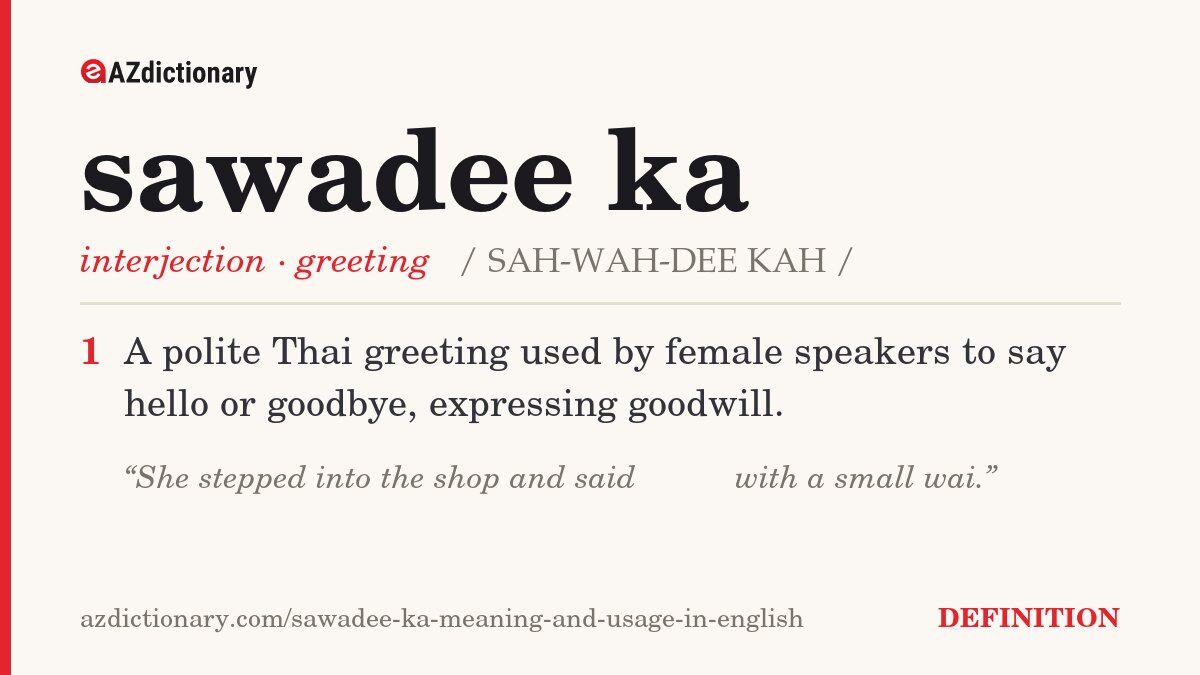
Sawadee ka (สวัสดีค่ะ) is a polite Thai greeting used by female speakers to say hello or goodbye; it combines the greeting สวัสดี with the female polite particle ค่ะ and is used in both everyday and formal situations, often together with the wai gesture to show respect.
([jamkham.com](https://jamkham.com/blog/what-does-ka-mean-in-thai/))
Part of speech: interjection, greeting
Pronunciation: SAH-WAH-DEE KAH (simple respelling). Thai: สวัสดีค่ะ.
Meanings
- 1. A polite greeting meaning “hello” or “goodbye” when spoken by a female speaker; it expresses a wish for the other’s wellbeing. ([sawadeeliving.com](https://sawadeeliving.com/sawadee-krub-vs-sawadee-ka/))
- 2. A short formula of goodwill, used to open or close an interaction politely; it can stand alone or be followed by other phrases. ([learnthaistyle.com](https://learnthaistyle.com/wp-content/uploads/2020/04/Speak-Thai-Stage-1-edition-2-EXAMPLE-BOOK.pdf))
Origin
The word สวัสดี (sawatdee) is ultimately derived from the Sanskrit svasti, meaning welfare or well-being, a loan that reached Thai through regional contact and classical languages. The polite particle ค่ะ (kha) is a sentence-final marker used by female speakers to signal politeness. ([archive.bukohome.com](https://archive.bukohome.com/content/wiktionary_en_all_maxi_2024-05/A/%E0%B8%AA%E0%B8%A7%E0%B8%B1%E0%B8%AA%E0%B8%94%E0%B8%B5))
Examples in sentences
- She stepped into the shop and said, “สวัสดีค่ะ,” with a small wai.
- When answering the phone, she began, “Good morning. สวัสดีค่ะ.”
- At the meeting the host greeted the group: “สวัสดีค่ะ, ยินดีที่ได้รู้จัก.”
- Leaving the temple, she bowed, placed her hands together and said, “สวัสดีค่ะ.”
Synonyms, antonyms and commonly confused words
Synonyms: hello, hi. Commonly confused: ค่ะ (kha) versus ครับ (krub) which is used by male speakers; different romanizations such as sawasdee, sawatdee, sawadee. Antonyms: none (a greeting, not oppositional).
FAQ
What does the phrase mean? It means hello or goodbye while also carrying a polite wish for the other person’s wellbeing; the particle ค่ะ marks the speaker as female and polite. ([jamkham.com](https://jamkham.com/blog/what-does-ka-mean-in-thai/))
When should a visitor use the female particle? Use ค่ะ only if you identify and speak as a female. Male speakers should use ครับ (krub). The particle follows Thai rules for polite speech and does not change to match the listener. ([sawadeeliving.com](https://sawadeeliving.com/sawadee-krub-vs-sawadee-ka/))
Do people always pair the greeting with a wai? It is common, especially in formal or respectful contexts; in casual urban settings a spoken greeting alone is also normal. ([en.wikipedia.org](https://en.wikipedia.org/wiki/Wai_%28gesture%29))
