

Pole, noun, has several common meanings: a long, usually cylindrical rod or post; either end of an axis such as the North or South Pole of Earth; a magnetic region of strongest polarity; and, in motorsport, the front starting place called pole position.
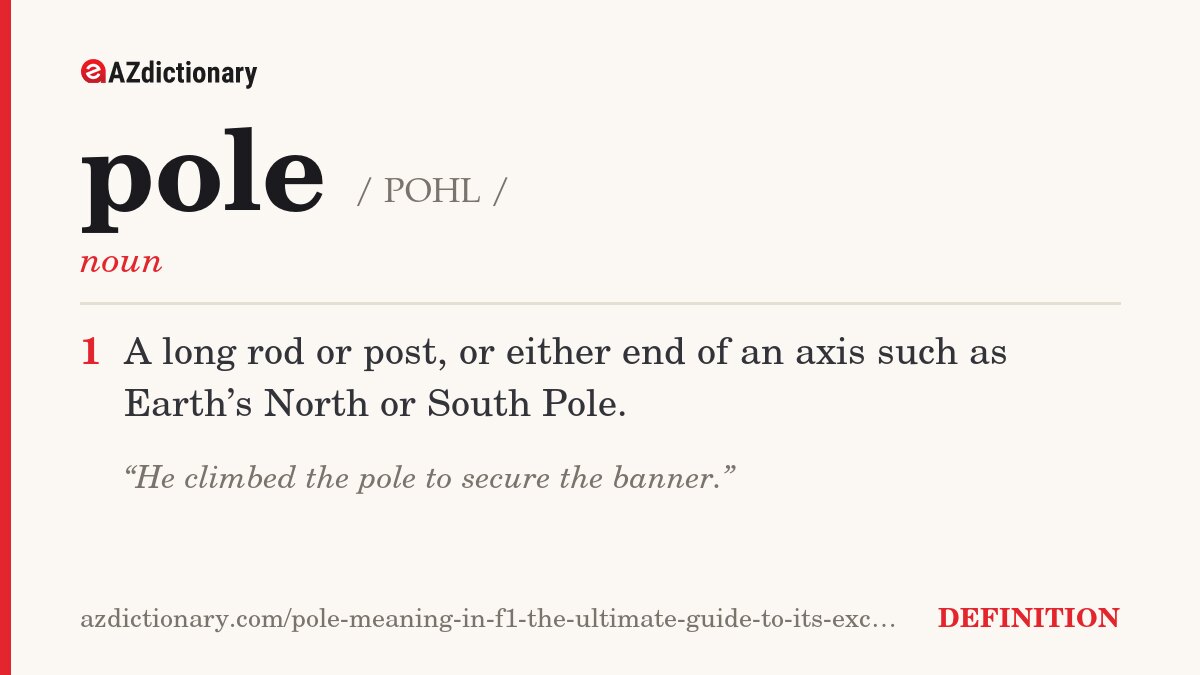
Part of speech: noun
Pronunciation: POHL
Meanings
- 1. A long, thin, usually cylindrical piece of material used as a support or boundary, for example a flagpole or telephone pole.
- 2. Either end of the axis of rotation of a sphere or planet, as in North Pole and South Pole; by extension, any extreme point of an axis or system.
- 3. A magnetic pole, meaning one of the two regions of a magnet where the magnetic force is strongest, commonly called north and south poles.
- 4. In mathematics and coordinates, the pole is the origin in a polar coordinate system.
- 5. In motorsport, especially auto racing, pole or pole position is the foremost starting place on the grid, awarded to the competitor who records the fastest qualifying time (or, at some events, the sprint winner).
- 6. Proper noun: a person from Poland is called a Pole, capitalized when used as a demonym.
Origin
The word represents at least two historical sources. The sense meaning a post or stake comes from Old English pāl, related to Latin palus. The sense meaning the end of an axis comes from Latin polus, from Greek pólos, meaning pivot or axis. Over time these forms converged in modern English spelling and pronunciation.
For a standard dictionary treatment see Cambridge Dictionary.
Examples in sentences
- The flag flew from the pole outside the town hall.
- Scientists have long studied climate patterns at the North Pole.
- The bar magnet’s south pole attracted the compass needle.
- In polar coordinates the pole plays the same role as the origin in Cartesian coordinates.
- After the final qualifying lap he secured pole position for Sunday’s race.
- She is a Pole who moved to the United States in 2005.
How pole position works in motorsport
- Qualifying sessions decide the starting order by fastest single laps; the competitor with the fastest time earns pole position and starts first on the grid.
- Formats vary by series: in Formula 1, qualifying usually uses a multi-part knockout format and the fastest driver in the final segment takes pole; some race weekends use a sprint whose result can determine the grid.
- Pole gives a clear track ahead and a tactical advantage at the start, but race outcome depends on many factors including strategy, pit stops and incidents.
- See an official motorsport glossary for current series rules and formats: F1 glossary.
Synonyms, antonyms and commonly confused words
Synonyms: post, stake, rod, staff. Antonyms: equator (for Earth’s poles in a geographic sense). Commonly confused word: poll, which is unrelated and refers to voting or head counts; poll and pole are homophones in some accents but are distinct words.
FAQ
- What does pole mean? Usually a long post or either end of an axis; context determines whether it refers to a physical rod, a geographic extreme, a magnetic region, or the lead starting place in racing.
- What does pole mean in F1? In Formula 1, pole or pole position is the front starting spot on the grid, awarded to the driver with the fastest qualifying time, except where a sprint result sets the grid.
- Is Pole capitalized? Yes, when used as the demonym for someone from Poland it is capitalized as Pole; the common noun senses remain lowercase.
