

Traduce means to harm a person’s reputation by making false or misleading statements; to slander or defame. The word denotes deliberate misrepresentation that exposes someone to shame or blame, often with the intent to damage standing or trust.
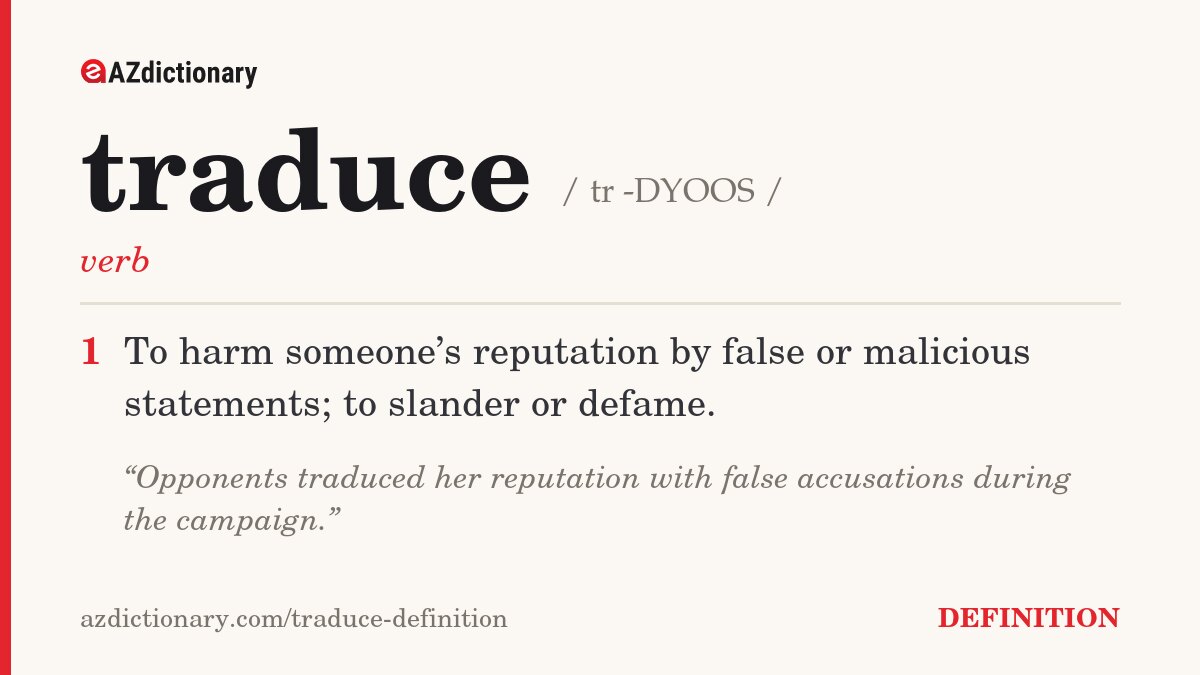
Part of speech: verb
Pronunciation: trə-DYOOS
Meanings
- To expose to shame or blame by false statements or misrepresentation; to slander or defame (modern, common use).
- To betray or violate trust; used in contexts where an action reveals or harms another’s interests or reputation.
- Obsolete or rare: to transfer, convey, or translate; historically recorded senses reflect the Latin root meaning “lead across”.
Origin
The verb comes from Latin traducere, literally “to lead across,” via Romance-language forms; the sense of disgrace or defamation developed in English. For the etymology and historical senses see Etymonline and modern dictionary entries such as the Oxford learner’s entry at Oxford Learner’s Dictionary.
Examples in sentences
- The newspaper article unfairly smeared her reputation with unverified claims.
- Political rivals spread malicious rumors that seriously damaged his public image.
- She refused to repeat the gossip because she would not join in maligning a colleague.
- The false allegations ruined the charity director’s standing in the community.
- After the report, many of his supporters were persuaded by the slander and withdrew their backing.
Synonyms, antonyms and commonly confused words
Synonyms: defame, slander, calumniate, malign, vilify. Antonyms: praise, honor, commend. Commonly confused words: translate (unrelated in modern English), traduce (do not confuse with translate despite shared Latin roots).
FAQ
What does traduce mean? It means to harm someone’s reputation by making false or misleading statements; essentially to slander or defame.
How is it different from slander or libel? The words overlap: slander and libel are legal or everyday terms for false injurious speech; traduce is a literary or formal verb that emphasizes the damage or disgrace caused.
Is the word commonly used today? It appears mainly in formal, literary, or legal-adjacent contexts; everyday speech more often uses slander, defame, or smear.
Can it mean “translate”? Historically there were senses related to carrying or translating, but in modern English that meaning is obsolete and the word is used for harming reputation.
Related Words
- defame
- malign
- slander
