

Witting means aware of something or done with knowledge or intent. It is an adjective used to describe actions or people who act deliberately rather than unknowingly. The adverb is wittingly, and the word commonly contrasts with unwitting in legal, literary, and formal contexts.
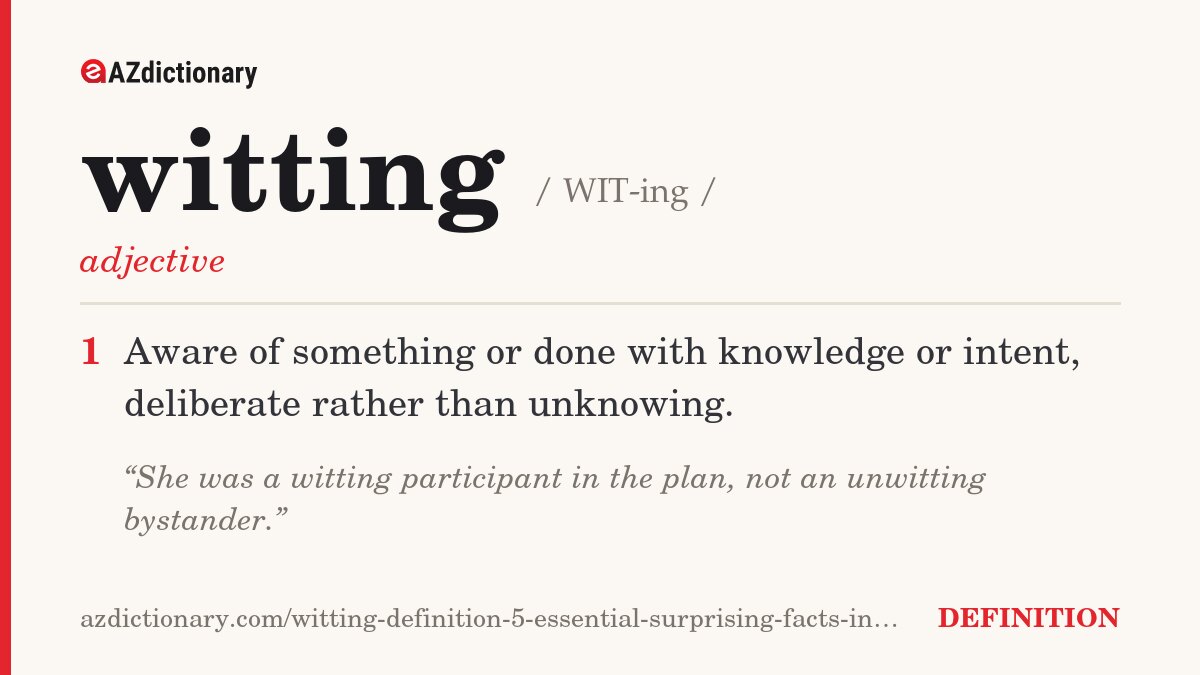
Part of speech: adjective
Pronunciation: WIT-ing
Meanings
- Deliberate, intentional: an act done knowingly, on purpose (for example, a witting decision to break a rule).
- Aware, knowing: having knowledge of a fact or situation (for example, a person who is witting of the risks).
- (Regional, noun) In some northern English uses, witting can appear as a noun meaning knowledge, though this is rare in modern standard English.
Origin
The word comes from Middle English witing, from the verb witen, based on Old English witan, “to know.” For dictionary definitions and usage notes see Collins Dictionary, and for etymology see Etymonline.
Examples in sentences
- He gave his witting consent to the plan, so he shared responsibility when it failed.
- The lawyer argued that the defendant was a witting participant, not an unwitting bystander.
- They claimed the company acted wittingly in withholding the safety report.
- Although old-fashioned in speech, the term still appears in court opinions and formal reports.
- She was witting of the errors but decided not to speak up.
Synonyms, antonyms and commonly confused words
Synonyms: intentional, deliberate, knowing, conscious. Antonyms: unwitting, unknowing, inadvertent. Commonly confused words: wit (mental sharpness), wittingly (adverb form).
FAQ
What does witting mean? Witting means aware of something or doing something with knowledge and intent. It describes deliberate or knowing action.
Is witting the opposite of unwitting? Yes, witting contrasts with unwitting: witting implies awareness or intent, unwitting means without knowledge or by accident.
Can I use wittingly instead? Yes, use wittingly when you need an adverb: for example, “He acted wittingly.” The adjective witting modifies nouns, as in “a witting accomplice.”
Is witting common in everyday speech? No, witting is less common in casual conversation and may sound formal or old-fashioned; it still appears in legal, historical, and formal writing.
