

Bold most commonly means willing to take risks or show confident courage; it also describes actions that are forward or impudent, colors or designs that are striking, and type set thicker than normal. The exact sense depends on context, from praise for bravery to criticism for cheekiness.
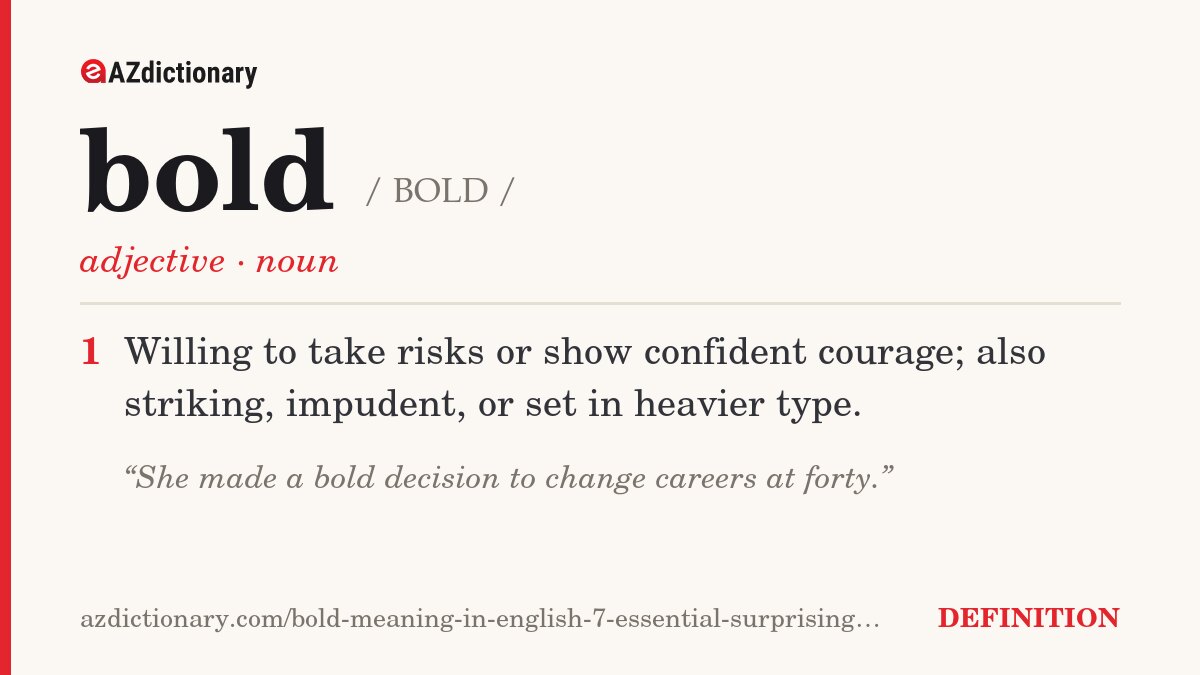
([merriam-webster.com](https://www.merriam-webster.com/dictionary/bold))
Part of speech: adjective, noun
Pronunciation: BOLD
Meanings
- Brave, daring, willing to take risks: acting without excessive fear when danger or difficulty is present. Example: a bold explorer.
- Forward or impudent: too confident in a way that may offend. Example: calling someone out can be seen as bold or rude.
- Striking, conspicuous, or strong in effect: used of colors, patterns, flavors, or design. Example: bold colors, bold flavors.
- Typography: printed or set in a heavier, darker face, called boldface. Example: a bold heading.
- Geographical or descriptive: steep or abrupt, as in a bold cliff. This sense is less common.
([collinsdictionary.com](https://www.collinsdictionary.com/us/dictionary/english/bold))
Origin
The adjective bold comes from Old English beald or bald, meaning brave or confident. It is from a Germanic root, Proto-Germanic *balþaz, and is probably related to an Indo European root that gives senses of swelling or strength. Modern senses expanded over centuries to include visual prominence and typographic use. See Merriam-Webster and Collins for full entries.
([etymonline.com](https://www.etymonline.com/word/bold))
Examples in sentences
- She made a bold decision to change careers at forty.
- The student was punished for being bold with the teacher.
- The poster uses bold type for the event date.
- He painted the room in bold blues and oranges.
- The climbers faced a bold, sheer wall at dawn.
Synonyms, antonyms and commonly confused words
Synonyms: brave, daring, courageous, audacious, striking. Antonyms: timid, cautious, meek. Commonly confused words: brazen (more strongly negative, implying shamelessness), confident (neutral, may imply steadiness rather than risk taking), boldface (specifically typographic).
FAQ
What does bold mean? In general, bold means willing to take risks or show confidence; depending on context it can also mean impudent, conspicuous, or printed in a heavier type.
Can bold be negative? Yes. Bold can praise courage, but it can also mean presumptuous or rude when someone oversteps social rules.
Is bold the same as brave? They overlap: brave emphasizes absence of fear, bold emphasizes readiness to act and may include recklessness or showiness.
How is bold used in typography? Bold refers to characters set in a heavier weight to make text stand out, commonly called boldface.
